
Canadian Atlantic Section News
C&S/SSC Joint Chapter Technical Talk
Title: Towards Autonomous Security: A Solution for the Evolving Threat Landscape
Speaker: Dr. Irfan Khan from Texas A&M University
Date and time: Thursday, November 16, 2023, 11:00h – 12:00h
Click here for more details and to register
October Networking Event

May Networking Event

March Networking Event

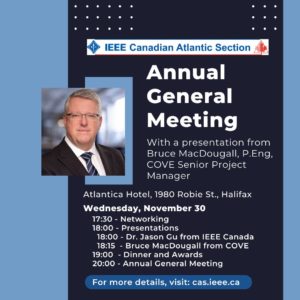
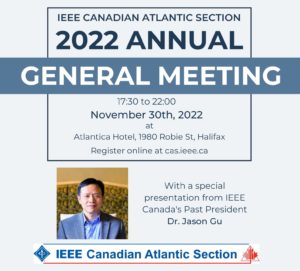
2022 IEEE Canadian Atlantic Section AGM
17:30 – 18:00: Networking
18:00 – 19:00: Presentation
19:00 – 20:00: Dinner and Awards
20:00 – 21:30: Annual General Meeting
Full AGM details can be found here and to register
CCECE Events
In the morning (9 am – noon), take a deep dive into Meta-Learning (a machine learning approach that is showing great promise), or learn about how to find and use relevant codes and standards in their capstone projects, research work, and eventual careers.
Then in the afternoon (1:30 – 4:30 pm) there will be a hands-on workshop using an effective tool to understand data pipelines for ocean data collected on platforms like autonomous underwater vehicles, while professors and those who are interested in academic careers may join the continual curriculum improvement panel to learn about what is happening across Canada to advance engineering programs.
The detailed descriptions of these tutorials are available on the CCECE 2022 website: https://ccece2022.ieee.ca/tutorials/
Registration is open to everyone, but there is a special price of $30 for students. Registration can be completed at this link: https://edas.info/r29368
We can be reached at tutorials@ccece2022.ieee.ca with any questions. If you are interested but cannot afford the session, please get in touch with us.
Looking forward to meeting you there!
Oceans Decade

2021 IEEE Canadian Atlantic Section AGM
18:00 – 18:15: Networking
18:15 – 19:15: Welcome address, and Technical Talk
19:15 – 19:30: Awards
19:30 – 21:00: Annual General Meeting
Full details can be found here
Newsletter
We released our latest newsletter issue to members on April 28, 2021. See the PDF here: CAS 2021 Newsletter, Issue 1
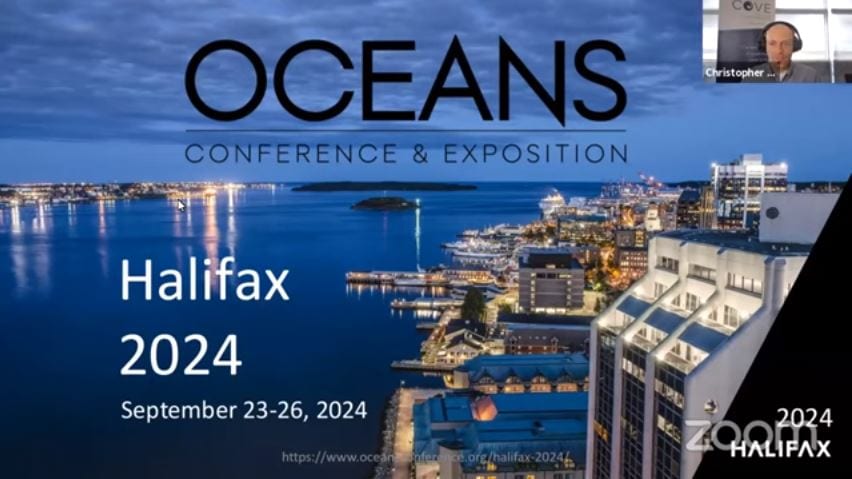
OCEANS 2024 Conference Set For Halifax
It was officially announced in late 2019 that Halifax was selected to host the OCEANS 2024 Conference. Earlier this year Christopher Whitt presented the conference to the local Ocean tech community as part of a virtual COVE Connector event. Check out the presentation here on Youtube.
2020 IEEE Canadian Atlantic Section AGM
18:00 – 18:45: Networking
18:45 – 19:45: Welcome address, and Technical Talk
19:45 – 20:00: Awards
20:00 – 21:30: Annual General Meeting
Full details can be found here
2019 IEEE Canadian Atlantic Section AGM
17:30 – 18:00: Networking
18:00 – 19:00: Welcome address, and Technical Talk by John Wood and Tony Wright
19:00 – 20:00: Dinner and Awards
20:00 – 21:30: Annual General Meeting
Full AGM Agenda can be found here
Preliminary Agenda (Oct.29)
- Approval of Agenda
- Reading and Approval of AGM 2018 Minutes
- Chair’s Report
- Reports
- Student Branch Reports
- Affinity Group Reports
- Chapter Reports
- Committee Reports
- Old Business
- New Business
- [ Motions ]
- Final Call for Nominations for Executive Positions
- Election / Acclamations
- 2020 Budget Presentation and Acceptance.
Adjournment
Technical Talk: Perspectives on Tidal Energy Development in Nova Scotia
Speakers: John Woods (Minas Energy) and Tony Wright (FORCE)
Tony Wright’s presentation will provide a FORCE point-of-view on tidal power development and the challenge of “working in water that moves over 20 kilometres an hour.” John Woods will talk about two of the FORCE berths (A & C) from a developer’s perspective. These include a total of 21 x 420 MW units, connected in two arrays. He will highlight some points on interconnectivity.
More details on the AGM can be found at here.
Remembering Professor Mohamed “Mo” El-Hawary (1943-2019)
Earlier this year our Section lost one of its founding members and leaders, Professor “Mo” El-Hawary. We mourn his passing and express our condolences to his family. The Section Chair offered the following tribute at a Celebration of Mo’s life in Halifax on August 2, 2019. Remembering Mo – Tribute
The IEEE Spectrum recently published a tribute as well, which can be accessed at
https://spectrum.ieee.org/the-institute/ieee-member-news/paying-tribute-to-former-ieee-canada-president-mo-elhawary
Engineering Institute of Canada (EIC)
Engineering Institute of Canada has provided below useful links for both employers and job seekers:
Employers, register using the below link:
https://employers.engineeringcareers.ca/
Job seekers, register using the below link:
https://www.engineeringcareers.ca/
Employers can find the perfect candidate of the role. Job seekers can find their best engineering job. Please register and make use of these links.
 IEEE Canada News

- Congratulations to Maike Luiken!Many congratulations to Maike Luiken to win MGA William W. Middleton Distinguished Service Award on 17 June 2023 “For exemplary leadership and commitment to MGA, IEEE members and the public, and for championing technological solutions to sustainable development and climate change challenges.”
- 30 by 30 Conference 2022ngineers Canada at the 2022 30 by 30 conference, a three-day virtual gathering for 30 by 30 Champions, engineering regulators, engineering educators, engineers, students, employers, and other stakeholders. The Conference will take place from 12:00 p.m. ET to 2:00 p.m. ET on April 13, 20, and 27. The theme of the 2022 conference is Emerging […]
- Region 7 Events CalendarThe detailed Region 7 Events Calendar is available here.
- 50% Membership Discount for IEEE studentsStudents wishing to take advantage of the 50% discount can do so by using the promotion code FUTURE50 during the online check-out process for joining or renewing their IEEE membership.
- New deadline: Nominations of candidates for 2022 IEEE Canada volunteer positionsThe deadline for the Call for Nominations of candidates for 2022 IEEE Canada committee vice-chair, committee member and other positions has been extended to July 14th (extended) – please, see https://www.ieee.ca/en/volunteering/
- Member Benefit: The Personal Auto and Home Insurance ProgramThe Personal Auto and Home Insurance Program As a member of IEEE in Canada you get access to exclusive home and auto insurance rates with The Personal that are not available to the general public. As a group insurer, The Personal offers customized coverage, priority service, and a seamless experience every step of the way.
- Member Discount on Dell ProductsIEEE members in Canada can take advantage of the Dell Member Purchase Program Benefits.
- Group Insurance ProgramAs an IEEE member in Canada, you’re entitled to take advantage of this valuable portfolio of member benefit insurance options. Thousands of technology professionals have used the IEEE Member Group Insurance Program as a convenient, cost-effective addition to their family’s financial plan for more than 50 years.
- Special Member BenefitIEEE Day is celebrated annually on the first Tuesday of October. In honor of IEEE Day 2020, which was celebrated on 6 October 2020, IEEE is offering several IEEE Special Day benefits to the members.
- IEEE DayIEEE Day is celebrating the first time in history when engineers worldwide and IEEE members gathered to share their technical ideas in 1884. Worldwide celebrations demonstrate the ways thousands of IEEE members in local communities join together to collaborate on ideas that leverage technology for a better tomorrow.
